Italy is starting to pull back units from the NATO "Unified Protector" mission over Libya. The reason is lack of money. The financial crisis in Europe has resulted in Greece having to get loans from the European Central Bank in order to stabilize their economy. Italy and Spain is next on the PIIGS list of countries who are very near the same financial disaster as Greece. Both Italy and Spain are involved in "Unified Protector" and probably both countries will reduce their involvement in the operation.
First to leave is the Italian aircraft carrier Garibaldi.
"We have cut back costs in Libya, from 142 million euros forecast in the first half of the year to less than 60 million for the second half," Defense Minister Ignazio La Russa said after a government meeting.
The news came after Italy's Cabinet moved to cut spending military spending.
The plan had been drawn up to pull the Garibaldi, its three fighter jets and 1,000 personnel out of the mission as they were "no longer necessary", La Russa said.
What will the future be for the Italian Air Force? Lt. Gen. Giuseppe Bernardis, Chief of Staff, Italian Air Force has in an interview discussed his view on "Unified Protector" and the Air Force future. Focus is of course the replacement of Tornado and AMX with F-35A/B aircraft.
Q. The Italian Air Force has planned to replace its AMX fighter bombers with the short-takeoff-and-vertical-landing F-35B, starting from 2014, before replacing its Tornados with the F-35A. But Defense Undersecretary Guido Crosetto has hinted that buying just F-35As might be the order of the day, given the delays in the STOVL program.
A. We still have a need for both an F-35A and B. The delay of the B is not a problem. We are ready to reconsider the whole thing in light of the probation period for the B. We are ready to switch to the A as the initial order. We do not forsee IOC [initial operational capability] before 2018 in Italy for either type, and the first ones will remain in the U.S. for training purposes. The buildup of the F-35A fleet would be at the end of the decade, as the Tornados draw closer to being phased out.
Q. One advantage of the getting the Bs first was that the AMX, which they are due to replace, will be retired before the Tornados. What happens if the AMX phaseout starts before the Bs arrive?
A. AMX phaseout will start gradually, and it is scheduled to take place without losing significant operational capabilities due to the fact that aircraft with the latest upgrades will be dismissed last. In this way, we will still perform all the assigned missions, only with fewer aircraft.
The UK has used their Eurofighters for strike missions. But Italy has focused on using Eurofighters for CAP - Combat Air Patrol to secure the NFZ - No Fly Zone. Initially this was performed by F-16 ADF. The air to ground missions have been performed by Tornado IDS and AMX. SEAD missions by Tornado ECR and IDS. Recce missions by Tornado IDS. Italy are planning to remove the Eurofighters altogether from Unified Protector since there is little need for fighters over Libya and instead increase the number of AMX involved. This is of course also a financial decision since the Eurofighters are more expensive to operate than the AMX.
The Italian Eurofighters have during June been on Iceland for training. Maybe they will support NATO in the air defence over the Northern Seas together with UK and Norway instead of the Libyan mission? In this way UK can focus more on the Libya mission.
Will Italy be able to continue with the introduction of both Eurofighter and F-35?
There is one big advantage by operating two different types of aircraft. If there is e technical malfunction that affects the whole fleet of aircraft there is an alternative solution to be able to continue flying. That is one of the major reasons why USAAF traditionally has been operating at least two different types of fighter aircraft and also why there are at least two different design bureaus involved in an offer to produce the next fighter aircraft. But this is also a very costly solution. Two aircraft types results in two logistic needs for spare parts etc and the need for training pilots and technical personnel on two types. However since Italy buys the aircraft together with other nations they can use other nations facilities for training and other nations logistics for international missions.
Tranche 3B of the Eurofighter development has been put on ice. This means no AESA-radar for the Eurofighter and bad news for UK/Italy company Selex Galileo. But since Italian Alenia Aeronautica is a member of the Eurofighter consortium, they will most likely put political pressure on the Italian government to continue with the Eurofighter upgrades. Italy has a big part in the Eurofighter production.
19.5% Italy (121). Alenia Aeronautica: Left wing, outboard flaperons, rear fuselage sections
Note: Italy has already cut down the number of Eurofighters on order from 121 to 96.
My guess is that the Italian Air Force will have to cancel their order of the F-35B. The rising prize of the F-35 in combination with the Italian bad economy will result in cuts in their Air Force. But there are Italian companies involved in the local production of F-35 and they will of course also put political pressure on the Italian government.
I also believe that it will be very expensive for the Italian Air Force to have both Eurofighter and F-35 with the same type of capabilities. Most probably the Eurofighters will focus on the Air dominance missions (as they have done so far during Unified Protector) with a second hand role of doing air to ground missions while the F-35 will focus on what the Tornado and AMX do well ant that is strike and recce missions. The Eurofighters will most likely never be upgraded to increase their air to ground capability. I am not exactly sure what Tranches the Italian Eurofighters belong to and if all will be retrofitted to Tranche 2 standard or only to Tranche 1 Block 5 standard by the R2 update program. Today only the UK has Typhoon FGR4 with capability to carry Litening Laser Designator Pods and Paveway Laser Guided Bombs. (The picture above is from flight testing).
Here is a summary of all Eurofighter Tranche and Block variants.
It will be interesting to see which aircraft manufacturer (EADS, Lockheed Martin) that has invested the most in Italian aircraft industry. My money is on that the Eurofighter will win this financial battle.
Together with the cuts in the Air Force Italy will most likely be one of the first nations to start cut their forces in Afghanistan. Today there are 4.200 troops in Afghanistan. Since Obama has set the time line for 2014 withdrawal, this gives the excuse for Italy to start removing their troops. The economy will in this case be a more decisive factor than actual success in stabilizing Afghanistan.
The bad Italian economy can affect Sweden's military operations as well.
- Italian withdrawal from Libya will increase the need for other countries to continue. Swedish Gripens fly 25% of all recce missions over Libya and deliver 37% of all photos produced. The UK has sent four extra Recce Tornado down to the Mediterranean, but there will always be need for intelligence. Maybe Italy can provide extra intelligence with their Raptor UCAV, but they are still not yet operational. This might also put extra pressure on Sweden to start using the Gripen in air-to-ground role, but I suspect that even if NATO asks for this type of capability, there will be no Swedish political will to do these types of mission.
- In Afghanistan the Swedish government is planning to remove the Swedish troops by 2014. The removal were planned to start 2011, but so far nothing has happened! On the contrary Sweden has sent down to HKP 10 Super Puma helicopters that will be replaced by HKP 16 Blackhawks in 2013 and there is ongoing plans to send down Shadow 200 UAV at the end of 2011. There has been very few political discussions on how the other nations troop removals will affect the security in Mazar-i Sharif and how to synchronize the Swedish removal with that of the others. If some nations, e.g. Italy start to emove their troops ahead of the major pull back, then other countries will have to take a larger part of the overall mission. Since the economy of Sweden is one of the strongest in Europe I would not be very surprised if NATO asks Sweden to increase rather than decrease the number of troops in Afghanistan until 2014.
Showing posts with label Economy. Show all posts
Saturday, August 6, 2011
Thursday, July 21, 2011
All is Well for Saab
At this moment, the stockholders at Saab Defence can be very optimistic about the future of the company. The latest six months financial report showed a major increase in profit compared to last year.
Operating income was MSEK 1,065 (402), corresponding to an operating margin of 9.4 per cent (3.5). 2011 included capital gains of MSEK 253, whereas the Group in 2010 had structural costs and negative results from divestments of MSEK 110 and costs related to a terminated contract of MSEK 310.
Saab has also reported the sale of C3 Technologies. A spin-off 3D mapping company. In the short term this will increase the income for the third quarter 2011.
The cash consideration for the divestment amounts to approximately MSEK 1,009 and the transaction will generate a capital gain of approximately MSEK 906. It will have a positive impact on earnings per share fully diluted of approximately SEK 8.1 in 2011.
Unfortunately Saab is, as most other major companies on the stock market, focusing on making the stock holders happy and sharing the income with them rather than re-investing the money into the Gripen NG program. Of course it is always good to make the investors happy and maybe earn some short term money by increasing the value of the Saab stocks. But the aircraft industry is a long term business and need money today. As most other European military aircraft manufacturers, Saab is at this moment very vulnerable. The ongoing production will end in a few years when the last aircraft on order for the Thai, South African and Swedish Air Force has been delivered. There are a number of possible customers for the Gripen C/D with the RTAF - Royal Thai Air Force as the most probable.
But the next version, the Gripen NG or Gripen E/F has yet to find a customer. The Swedish Armed Forces will wait another year. The Brazil Air Force are doing the same and the Indian Air Force are at the moment focusing on Eurofighter or Rafale. How will Saab find money to develop the Gripen NG on their own? Maybe by keeping some of the earnings and reinvesting them into the Gripen NG instead of spreading the all of it to the stock-holders.
But maybe there is another financial possibility around the corner. The civilian production has long been a slow goer. Saab is delivering part to both Airbus and Boeing, but the Boeing Dreamliner is delayed and the Airbus 380 has not sold as much as expected. But now American Airlines is going to buy 460 aircraft from both Boeing and Airbus. Not the new fancy aircraft, but the Airbus 320 and the Boeing 737 in their latest development versions. Airbus has already presented plans on how to speed up the production rate to 60 A320 per month!
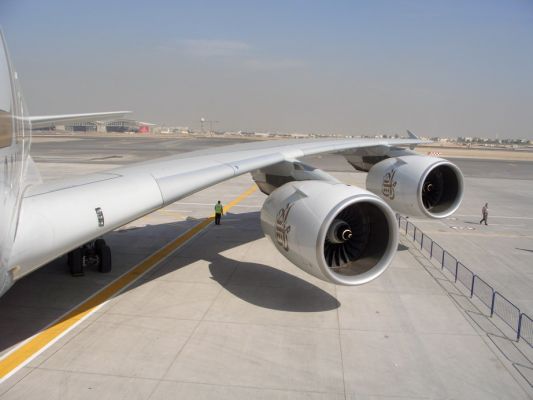
Saab is manufacturing parts of the wing structure on the Airbus 380. The knowledge on building these kind of structures come from the military Gripen project. This clearly shows the symbiosis between the civilian and the military production. But up until now maybe the technical advanced development has been on the military side of the production. But maybe this is to be changed?
And Saab also have some very promising technologies that might be part of the updated Airbus 320. As part of the EU project Clean Sky in the sub-project SFWA - SMART Fixed Wing Aircraft, Saab has developed a turbulence "free" wing where major parts are made in one single composite structure with a very smooth layer. In 2014 this new wing will be tested on an Airbus 340. If these tests goes well it is very likely that Saab will manufacture the wings of the next generation Airbus 320, the A30X. The first prototype of the wing was presented in April 2011.
"The production of the integrated wing panel is groundbreaking. The material being used is the latest carbon-fibre composite available on the market. There are stringent, if not extreme demands on the surface quality in terms of permitted steps, play and waviness, and this was the biggest challenge we faced with regard to the composite items," says Thomas Hellström, project manager at Saab for SFWA.
Saab's expertise within aerodynamics has been essential in the development of the wing panel and the team has worked hard to improve the wing's aerodynamic properties in order to maintain the laminar flows so that the air resistance and fuel consumption can be reduced by at least 5 %.
The US DoD is also studying fuel efficiency. Not only to be "green", but also to increase the range of aircraft while decreasing the need for vulnerable fuel transports to operations. Maybe this civilian technology also will be valuable on the military market?
"In addition to traditional performance parameters such as speed, range and payload, we will now consider system energy performance parameters in the requirements and acquisitions process," deputy defense secretary William Lynn said during his speech.
The last years it has been the military sales that has saved Saab civilian production, but maybe it is now time for the civilian production to save the military?
American Airlines is not the only airline company that need to buy new aircraft to replace their ageing fleet. SAS has bought 30 Airbus A320neo, Indian GoAir has bought 72 Airbus A320neo, Indian IndiGo has ordered 180 Airbus A320, China buys 88 Airbus A320 and so on...
Maybe it is not a few big business opportunities that will make the big money for Saab, but many small?
Saab is not the only Swedish winner. American Airlines and the other new orders will also make life good for Volvo, since they are delivering parts of the engines for almost all possible engines that will be delivered with both Airbus and Boeing aircraft.
SvD1, SvD2, Corren
Subscribe to:
Posts (Atom)