Showing posts with label Saab. Show all posts

Saturday, October 1, 2011

The end is near

The next few years are very decisive for Swedish aircraft manufacturer Saab AB. The Gripen assembly line will soon be closed due to lack of customers. The only aircraft left to build is Thai Air Force batch 2 (6 aircraft), a few of the South African (most of the 26 on order has been delivered) and a few of the Swedish A2C updated Gripen (31 on order). Most likely this will finished in a few years time. This lack of future sales is however a common problem for all three major European military aircraft manufacturers.

What will happen after this?

- Thai Air Force will most likely buy some more aircraft. 12 Gripen is not a lot to build the future of their air defence capability on. At least 6 to complete one squadron of strength. If the introduction of the Gripen goes well it is likely that they will order another 18 to replace all their F-5. Somewhere in the future it will be a need to replace their F-16. But who knows what the political situation in Thailand will be then? The old king Bhumibol will not live forever and there is no heir that is as accepted as the king. The new prime minister Yingluck Shinawatra will most probably give her brother Thaksin amnesty in the future. What kind of political unrest this ould lead to is hard to predict, but it will not make it easier to sell any more aircraft to Thailand.

- Two of the existing customers have troubles. Tho global financial problems have affected South Africa and Hungary and resulted in lack of money to operate their new aircraft. Of course this will be used by other companies to market their products. But it will be very difficult for them to show that their products are less costly to operate than the Gripen. The choice is between Gripen aor no fighter at all in the future. The outcome of such an campaign could be that there will be no fast jets at all operated in the future in these countries. Rumours say that USA is trying to convince Hungary to focus on helicopters instead of fighters.

- The Czech Air Force leasing contract ends in 2015. What will happen after this is still unknown. The pilots are very happy with their existing aircraft, but pilots don´t decide the future of their air forces, politicians do. Most likely USA and Lockheed Martin are doing their best to offer a "cheap" F-16 solutions in a similar way as for Poland. The F-16 is an older and less capable aircraft than the Gripen, but maybe closer ties to USA and NATO are more important for Czech politicians than the aircraft initself?

The new contracts are still to be decided. But new development in some countries might lead to fast decisions.

- The Swedish minister of defence is publicly stating thet if Brazil buys the Gripen E/F, then the Swedish Air Force will also by at least 10 Gripen E/F. Why he goes out with this message is unclear, but most likely it indicates that the Brazilian government is close to making a deal. The previous president Lula had close ties to France (Rafale), but president Dilma seems it is more important to have close ies to USA (F-18). Unfortunately Sweden is a small player on the global political arena and this might result in a second place in the competition.

- In India the Gripen is not in the MMRCA-competition any more. But there are other business deals in India that might be more attractive to Saab. The MRMR competitin is still ongoing.

Swedish defense and aerospace company SAAB is planning to offer its SAAB 2000 aircraft to the Indian Navy when it issues a Request For Proposal (RFP) for Medium Range Maritime Reconnaissance (MRMR) aircraft in the next few months.

While the SAAB 2000 is being offered with the RBS-15 Anti Ship Missile and a fifth generation Selex AESA radar, what is also interesting is that SAAB is offering re-manufactured aircraft, since the company ceased production of the aircraft in 1999.

“We will take an existing SAAB 2000. We will re-manufacture it and build it up. So it will be ground zero flying hours. We will have all the warranties. We will have 35,000 flying hours. It will have 25 years of support,” said Tommy Hultin, SAAB’s Business Development Director for the program.


That is one reason to why Saab still focusing on India.

This centre is a part of Saab's future offer for the world market. The aim of the research and development centre is to transfer to India continuously, already identified concrete programmes and technologies. The centre will form a bridge between India and Sweden, and together with an initial base of 100-300 skilled Indian engineers, form the backbone of the centre. It will stimulate innovation all around India, said Saab president and CEO Hekan Bushke.

The areas of focus would cover aerospace, defence and urban innovation, including civil security. The centre will be established in cooperation with Indian partners and universities, and will create new innovations, new technology and exporting opportunities for Indian governmental, academic and industry entities.


There are also other interesting Saab products for India. The RBS 70 NG has lately been offered.

The Swedish defense company, Saab, has offered the RBS 70 NG for the Indian tri-service tender for Very Short Range Air Defense (VSHORAD) systems. The tender is for an initial order estimated to be worth INR 27,000 crore (USD 5.4 billion) for over 800 launchers and over 5,000 missiles. Saab says it has sold more than 1600 systems and 17,000 missiles to 18 countries. This could be its single largest order if it works out for them.

- Switzerland has been evaluating fighters for many years to replace their F-5. The evaluation has been stopped more than once in order for the government to find political approval from the the voters. But now they have decided to go ahead with the evaluation again.

Parliament has approved an annual budget of SFr5 billion ($5.6 billion) for Switzerland’s armed forces, including the purchase of fighter jets.

The Senate on Wednesday followed the House of Representatives in agreeing to pay for the new aircraft, despite opposition by the centre-left which is concerned about costs in other areas. Critics also pointed out that the bill could not be challenged to a referendum.


It is not clear if the Suiss Air Force will go for the Gripen E/F or if the budget will only allow them to focus on the Gripen C/D. After all Switzerland is not a big country and the extra range of the Gripen E/F might not be a decisive capability.

I personally believe that Saab´s main focus should be to sell the cost effective Gripen C/D to countries with a low budget instead of competing with the Gripen E/F against the more expensive Rafale, Eurofighter, F-35 and PAK-FA T-50. Unfortunately the countries interested in an inexpensive capable fighter as the Gripen C/D (Croatia, Bulgaria, Rumania etc.) has almost no money at all. There is a need for a deal that gives something in return for these countries. But EU rules today forbid so called offset affairs (if you buy something from me, then I buy something from you).

What will the Swedish government do? They have officially declared that Gripen will be the backbone of he Swedish Air Force until at least 2040. But in order to do so Saab must survive as a manufacturer of aircraft to be able to support the future operational usage of Gripen. Maybe the Swedish government must support Saab in the same way as France supports Rafale? This was the way it was done during the development of the earlier Saab Viggen. A very close cooperation between the Swedish Defence Material Administration, FMV and Saab. In this way the price of export Gripen could further be lowered on the global market. The only thing that might stop this is EU rules, forbidding governments to support and favor their local industry. But when it comes to national security these rules can always be overruled.

Maybe this is a reason to why Sweden has started a governmental organisation FXM to coordinate the government and industry when it comes to large sales on the international market. After all the Swedish government can offer financial support connected to the state bank, offset affairs when it comes to buy military equipment from this specific country instead of others and the Swedish industry can offer offset affairs when it comes to development of sub-systems in the Gripen and maybe in some cases local assembly of the complete aircraft.

Dassault and Lockheed Martin has a lot of support from their governments. It would be very naive of the Swedish government to believe that Saab could survive on the international market without their support. It would also be very naive of Saab to believe that they can do this on their own and that they do not need their Swedish customer.

Thursday, July 21, 2011

All is Well for Saab

At this moment, the stockholders at Saab Defence can be very optimistic about the future of the company. The latest six months financial report showed a major increase in profit compared to last year.

Operating income was MSEK 1,065 (402), corresponding to an operating margin of 9.4 per cent (3.5). 2011 included capital gains of MSEK 253, whereas the Group in 2010 had structural costs and negative results from divestments of MSEK 110 and costs related to a terminated contract of MSEK 310.

Saab has also reported the sale of C3 Technologies. A spin-off 3D mapping company. In the short term this will increase the income for the third quarter 2011.

The cash consideration for the divestment amounts to approximately MSEK 1,009 and the transaction will generate a capital gain of approximately MSEK 906. It will have a positive impact on earnings per share fully diluted of approximately SEK 8.1 in 2011.

Unfortunately Saab is, as most other major companies on the stock market, focusing on making the stock holders happy and sharing the income with them rather than re-investing the money into the Gripen NG program. Of course it is always good to make the investors happy and maybe earn some short term money by increasing the value of the Saab stocks. But the aircraft industry is a long term business and need money today. As most other European military aircraft manufacturers, Saab is at this moment very vulnerable. The ongoing production will end in a few years when the last aircraft on order for the Thai, South African and Swedish Air Force has been delivered. There are a number of possible customers for the Gripen C/D with the RTAF - Royal Thai Air Force as the most probable.

But the next version, the Gripen NG or Gripen E/F has yet to find a customer. The Swedish Armed Forces will wait another year. The Brazil Air Force are doing the same and the Indian Air Force are at the moment focusing on Eurofighter or Rafale. How will Saab find money to develop the Gripen NG on their own? Maybe by keeping some of the earnings and reinvesting them into the Gripen NG instead of spreading the all of it to the stock-holders.

But maybe there is another financial possibility around the corner. The civilian production has long been a slow goer. Saab is delivering part to both Airbus and Boeing, but the Boeing Dreamliner is delayed and the Airbus 380 has not sold as much as expected. But now American Airlines is going to buy 460 aircraft from both Boeing and Airbus. Not the new fancy aircraft, but the Airbus 320 and the Boeing 737 in their latest development versions. Airbus has already presented plans on how to speed up the production rate to 60 A320 per month!

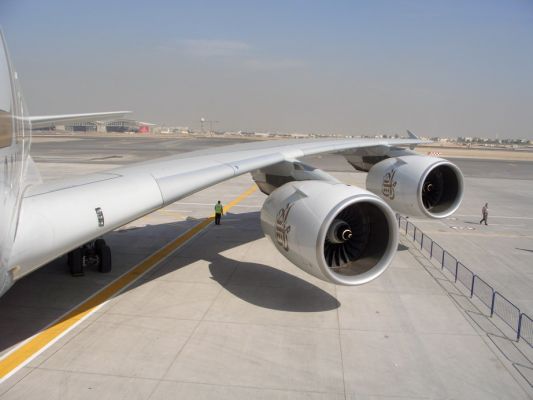
Saab is manufacturing parts of the wing structure on the Airbus 380. The knowledge on building these kind of structures come from the military Gripen project. This clearly shows the symbiosis between the civilian and the military production. But up until now maybe the technical advanced development has been on the military side of the production. But maybe this is to be changed?

And Saab also have some very promising technologies that might be part of the updated Airbus 320. As part of the EU project Clean Sky in the sub-project SFWA - SMART Fixed Wing Aircraft, Saab has developed a turbulence "free" wing where major parts are made in one single composite structure with a very smooth layer. In 2014 this new wing will be tested on an Airbus 340. If these tests goes well it is very likely that Saab will manufacture the wings of the next generation Airbus 320, the A30X. The first prototype of the wing was presented in April 2011.

"The production of the integrated wing panel is groundbreaking. The material being used is the latest carbon-fibre composite available on the market. There are stringent, if not extreme demands on the surface quality in terms of permitted steps, play and waviness, and this was the biggest challenge we faced with regard to the composite items," says Thomas Hellström, project manager at Saab for SFWA.

Saab's expertise within aerodynamics has been essential in the development of the wing panel and the team has worked hard to improve the wing's aerodynamic properties in order to maintain the laminar flows so that the air resistance and fuel consumption can be reduced by at least 5 %.


The US DoD is also studying fuel efficiency. Not only to be "green", but also to increase the range of aircraft while decreasing the need for vulnerable fuel transports to operations. Maybe this civilian technology also will be valuable on the military market?

"In addition to traditional performance parameters such as speed, range and payload, we will now consider system energy performance parameters in the requirements and acquisitions process," deputy defense secretary William Lynn said during his speech.

The last years it has been the military sales that has saved Saab civilian production, but maybe it is now time for the civilian production to save the military?

American Airlines is not the only airline company that need to buy new aircraft to replace their ageing fleet. SAS has bought 30 Airbus A320neo, Indian GoAir has bought 72 Airbus A320neo, Indian IndiGo has ordered 180 Airbus A320, China buys 88 Airbus A320 and so on...

Maybe it is not a few big business opportunities that will make the big money for Saab, but many small?

Saab is not the only Swedish winner. American Airlines and the other new orders will also make life good for Volvo, since they are delivering parts of the engines for almost all possible engines that will be delivered with both Airbus and Boeing aircraft.

SvD1, SvD2, Corren

Sunday, July 3, 2011

Tomorrow Brazil and India, Today Sweden

Selling combat aircraft is a work like no other. The decisions of nations on which aircraft to buy has nothing to do with strategy or even finances. Politics is the most important factor!

In India Saab is supposed to be out of the competition, or are they? No one really knows for sure. According to official press releases India will go forward with Eurofighter and Rafale, but Lockheed Martin has objected and most probably the decision will wait for a while.

In Brazil the FX-2 competition seems to be at a stand-still. And out of the ashes comes FX-3! Brazil want a new competition, but this time they will also make room for the 5:th generation of aircraft. F-35 and PAK-FA T-50 will probably be invited.

For this increase to 36 fighters, there would be "Chavez Factor" with their purchases of armaments on a large scale and attraction of the Cold War to the American South, "Chavez Factor" showed to Brazilian society that it does not have the height of Defense country for decades.
...
This purchase of the FX-2 could be far higher, because the original FX aimed assembly in Brazil, under license, in a next phase, 84 aircraft model has perfected the first choice, coming to total 120 aircraft interception. Only Chavez plans to reach 150 Su-30 and Su-35BM for its Venezuela. An acquisition is not less than this would cause local assembly or could count on full transfer of technology. Even 120 units produced under license does not guarantee transfer of technology obsolescence.


In Sweden the Minister of Defence will wait for another year before deciding on the future for the Gripan fleet in the Swedish Air Force. Will it be an updated Gripen C/D+ with new avionics or will it be a Gripen E/F with a new fuselage with room for more fuel, weapons, a bigger AESA radar and the F414 engine? Unfortunately for Saab Volvo is together with some high ranking FMV officials doing their best to stop the Gripen E/F in favor for the Swedish license made RM12+ upgrade. No one has yet asked General electric about how they will handle Volvo when it comes to competing a license made RM12 against General Electric F414. RM12+ will also be the end of the line for the F414 design. If Sweden in the future want more thrust it will need to be another engine instead of just upgrades.

But, during this waiting period there is still a lot of work ongoing at Saab.

FMV has recently announced a 1034 MSEK order on upgrades to the Gripen C/D fleet. This will ensure the work at Saab AB in Linköping, Kista, Mölndahl and Järfälla.

Do not forget that there are a number of existing customers who are operating the Gripen. 16 aircraft in South Africa, 14 in the Czech Republic, 14 in Hungary, 12 (so far) in Thailand and more than 100 in Sweden. There are also a number of countries that can not afford aircraft like the F-35 and ar very interested in a cheaper aircraft like the Gripen C/D. This is were the money for Saab is today.

This is something that is easily forgotten in the debate about Gripen E/F or not. The Swedish government has already decided to operate the Gripen until 2040. During these years there will be a need for continuous development of the aircraft. Sooner or later this will result in a major upgrade of the aircraft. Either by a number of smaller upgrades or by a major MLU - Mid Life Update.

There is of course the option of doing nothing at all. But this leaves two possible futures. Either there will be no Swedish Air Force at all or the Swedish Air Force need to replace their existing Gripen C/D with F-35 or a similar alternative starting somewhere around 2025. Will this alternative be cheaper? Ask the Norwegians!

SR

Sunday, June 26, 2011

The Two Saab

All is quiet in Trollhättan. No Saab automobiles are being build. No salaries are paid to the workers. Now everyone is waiting for financial support from China.

The problem is that there are two Saabs with the same company name and very confusing logotypes that easily can be mixed up. When I speak to people in other countries they often ask me if the manufacturer of Gripen will be bankrupt soon. What they don´t understand is that the aircraft and the automobile manufacturer are not the same company any more. The Saab automobile museum give us some clues to that there are more than one user of the Gripen logo.

Aircraft manufacturer
In the beginning it was only the aircraft manufacturer Saab in Linköping. It was founded in 1937 as Svenska Aeroflygplan AB. In 1965 the name was changed to Saab AB. In 1967 Saab was merged with Scania-Vabis and the name of the company was changed to Saab-Scania AB.

The first Saab logo was with their first manufactured aircraft, the Saab B 17 dive-bomber. The second logo that was used for a long time on all cars was with their twin engined Saab B 18 Bomber.

Today Saab AB uses a very similar logo to Saab Automobile with the head of the Gripen in the center. This has nothing to do with the Gripen aircraft.

The symbol was introduced in 1984 and was the symbol for the then Saab-Scania group. This is the first Saab logo to reintroduce the head of the mythical Gripen, or Griffin, first seen on the AB Scania-Vabis logo.

Saab Automobile AB introduced the new corporate symbol of the red Gripen head and gold crown with the name SAAB in silver beneath it all contained within a blue roundel.

The heraldic Griffin's head - derived from the coats of arms of the Skåne and Östergotland counties in southern Sweden traditionally symbolizes vigilance.

This logo was officially introduced on 14th August 2000, just months after the complete takeover of Saab Automobile AB by General Motors.

Saab say that the corporate symbol "...has now been refined to reflect more clearly the strengthening brand name and a model range which is the most competitive ever produced by Saab."


Automobile manufacturer
After the second world war the Swedish government wanted that Saab manufactured other things besides aircraft in order to be a more financial stable company. The first car prototype was shown in 1947. In 1949 Saab started to manufacture cars in Trollhättan. In 1990 Saab Automobile was separated from the aircraft manufacturer and half of the company was sold to GM - General Motors. At the same time Scania was made into a separate company within the Wallenberg Investor industrial sphere. However Saab Automobile still used a lot of branding from the aircraft industry and a lot of the car commercials showed Saab aircraft. The owner Wallenberg wanted that the car industry kept the high-tech image from the aircraft industry. In 2000 GM bought the rest of the stocks in Saab Automobile. Even after this sell-out Saab automobile still kept using the aircraft industry connections in their commercials.

In December 2009 GM decides to close down Saab. The company is bought by the dutch car manufacturer Spyker in January 2010. 6 April 2011 the production stops at at Saab due to financial problems. The Chinese company Hawtai buys stocks in Spyker. 15 June 2011 Spyker change name to Swedish Automobiles and sold the Spyker car plant to CPP Global Holdings.

Unfortunately there is today not much left of the well known Saab Automobile brand with driving legends like Erik "Carlsson på taket". Saab even had a short time in formula racing.


Saab future
Unfortunately the dying Saab Automobile are dragging the other Saab companies into the dark and deep pits of bad brands. My recommendation would be to be very careful when talking about Saab and distinguish between the two companies by using the full names "Saab Automobile" and "Saab AB" that is divided in a number of sub-companies among them "Saab Aeronautics" that manufactures the Gripen aircraft. And if I were in charge of selling Saab Automobile I would not let the brand "Saab", now sold to China, to be used for second class cars


Note the Gripen aircraft on the display behind the car in the video above. Note also how Saab Automobile President Jan-Åke Jonsson uses the word "pilots" to connect the car design to aircraft design.

Saab AB lawyers has stated that the Saab brand can not be sold separately to any buyer without buying he entire automobile manufacturer. This is regulated in a contract between Saab AB, Saab Automobile and Scania.

It will be very difficult to think about quality in the future when one hear the name Saab. Maybe it is to late to save the brand Saab? Maybe Saab AB (or Saabgroup) should be renamed to Saab Defence to distinguish it more from Saab Automobile? "Release me" is maybe still a campaign that should be used by Saab to release the Saab logo and Saab brand from the Chinese?


These commercials clearly show the link between the car manufacturer Saab Automobile and the aircraft industry. Saab Automobile has always used their connection to the aircraft manufacturer Saab AB as a quality mark.


Lastly an "oldie, but goodie" from the historical archives. The Saab stunt group was used in the same way as aerobatic display teams to sell the Saab car brand.


Read more in "SAAB Aircraft since 1937" by Hans G Andersson, ISBN 0-85177-886-0.

Interesting articles about the Saab logos here, here and here.

SvD1, SvD2, SvD3, SvD4, SvD5, SvD6, SvD7, SvD8, SvD9, DN1, DN2, DN3, DN4, DN5, DN6, DN7, DN8

Friday, June 24, 2011

Evolving Gripen

The Gripen NG - Next Generation has been flying for a few years as a technology demonstrator at Saab aircraft factory in Linköping. It has been offered to Norway and is also taking part in the bidding process in India (Gripen is today out of the bidding process togehter with F-18E/F, F-16IN and Mig-35) and Brazil.

However, in Sweden the politicians and the commander of the armed forces has difficulties to decide if they want to upgrade their existing fleet of Gripen A/B/C/D to E/F-standard or if they just want to upgrade them to C/D+ standards, without the modification of the airframe to be able to use the bigger F414-engine, carry more internal fuel and add two extra weapon pylons on the fuselage.

Many Swedish politicians does not want to buy more aircraft. They think that buying 204 aircraft for the Air Force and then reducing them to the now planned 100 Gripen C/D was a big mistake.

What the politicians do not understand is that if operational life of the Gripen aircraft is going to extended to the planned year 2040, there will be need of heavy modifications to the aircraft. Not only to meet future threats, but also to have spare parts to the electronic equipment in the aircraft. The Gripen system computer has already been upgraded three times with more modern electronics. The Gripen NG demonstrator has a complete new set of avionics that sooner or later need to be used also by the Gripen C/D aircraft. Not only to get extra capability, but also because there will be no other options to get spare parts for the old computers.

What the Swedish politicians has to study is the cost difference between rebuilding the existing C/D-fleet with just new avionics or also rebuilding them with a new airframe in the same way as 31 Gripen A/B has been converted to C/D-standard by rebuilding the fuselage and then adding wings, fin, engine and avionics from the old A/B-aircraft. There is still discussions if there is need of the bigger fuselage in order to carry the Selex/Galileo AESA-radar. If the smaller C/D-airframe is used, the Gripen must use a smaller radar disc, which add extra cost instead of just cooperating with the Eurofighter development program.

There are also big question marks regarding the possibilities for Volvo to build a updated RM12+ with more thrust. Will this be possible within the existing license agreement that Volvo has with General Electric? Unfortunately, Volvo has been lobbying heavily for using the RM12+ instead of the F414. This can be one of the major reasons for the Swedish politicians hesitations. If there is a possibility to get more thrust out of the existing engine, why buy a new fuselage only to cope with the bigger F414? What they miss is the fact that more thrust also result in the need for more fuel. More fuel also need a bigger engine in order to keep the aircraft performance. Otherwise the thrust-to-weight ratio will be too low. An aircraft need to be kept in balance. Weapons need to be balanced with sensors, engine with weight (including extra weapon and fuel) etc, etc.

Saab also need to have specialist personnel employed for heavier maintenance of the aircraft even if no new aircraft are built at the Linköping aircraft manufacturing plant. This in order to support the Swedish Air Force and other customers with heavier repairs on the aircraft after accidents. This due to the fact that this capability is not available on normal fighter wings. To keep this personnel trained it can be more effective to build extra fuselages for the modification of Gripen C/D to Gripen E/F in the same way as being done today with the modification from Gripen A/B to Gripen C/D.

The Swedish politicians must understand that there will be no new aircraft being built for the Swedish Air Force, just the existing 100 aircraft kept up to standards with the threat development and the development in technology.